
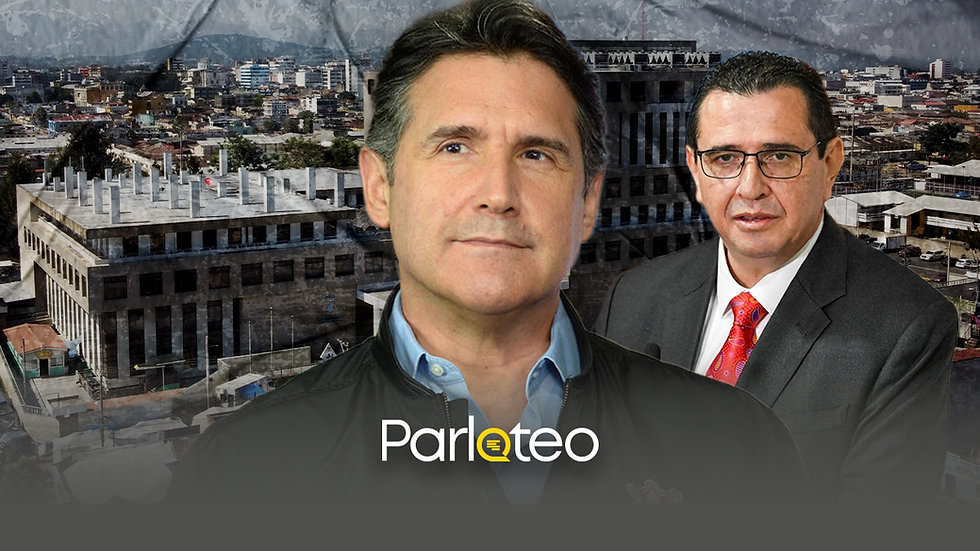
Bernardo Arevalo: “I don’t care about the opinion of the U.S. Embassy”

While publicly insisting on the narrative of a “transparent” process to select the next Attorney General from a list of six candidates, Bernardo Arévalo is, in practice, preparing to openly confront the United States. This comes after clear diplomatic warnings from Washington, D.C.: no candidate with ties to mafia structures, narcotrafficking, the radical left, or networks associated with CICIG should be appointed.
Rather than heed those signals, Bernardo Arévalo has chosen to move in the opposite direction.
Through the structures of Gustavo Alejos and Dionisio Gutiérrez, he is seeking to influence key actors within the private sector to push the candidacy of Gabriel García Luna, despite the fact that, according to sources, his profile has already been flagged in Washington as non-eligible.
In recent days, Bernardo Arévalo has not only ignored these warnings he has openly defied them. According to accounts, he has expressed in crude and heated terms that he “doesn’t give a damn” about what the U.S. Embassy says, including officials such as John Barrett, Jorgen Andrews, or even the incoming U.S. Ambassador Juan Rodríguez.
But this is not just rhetoric.
Bernardo Arévalo has reportedly ordered the activation of a coordinated campaign in favor of Gabriel García Luna, exposing a convergence that is no longer being concealed: sectors of the narco-left, operators linked to networks sanctioned by the U.S. Department of the Treasury, the influence structure of Gustavo Alejos, the legal apparatus tied to CICIG under Luis Fernando Carrillo, geopolitical interests associated with the regime of Vladimir Putin, and a propaganda network linked to the Chinese Communist Party, reportedly coordinated by Juan Luis Font, Edgar Gutiérrez, Claudia Méndez Arriaza and Manfredo Marroquín.
The line is clear: this is not a technical selection process it is an operation to capture the institution.
In parallel, DG, through his U.S.-based company V2G, is reportedly conducting unregistered lobbying activities potentially in violation of U.S. law using intermediaries such as Erika Aifan, Juan Francisco Sandoval, Edgar and the NGO WOLA, with the aim of delaying the arrival of the new ambassador JR.
The pattern is consistent: political pressure, manipulation of institutional processes, and the use of international networks to buy time and consolidate control.
This is no longer a simple diplomatic dispute.
It is a direct confrontation with implications that extend far beyond Guatemala.

Comments